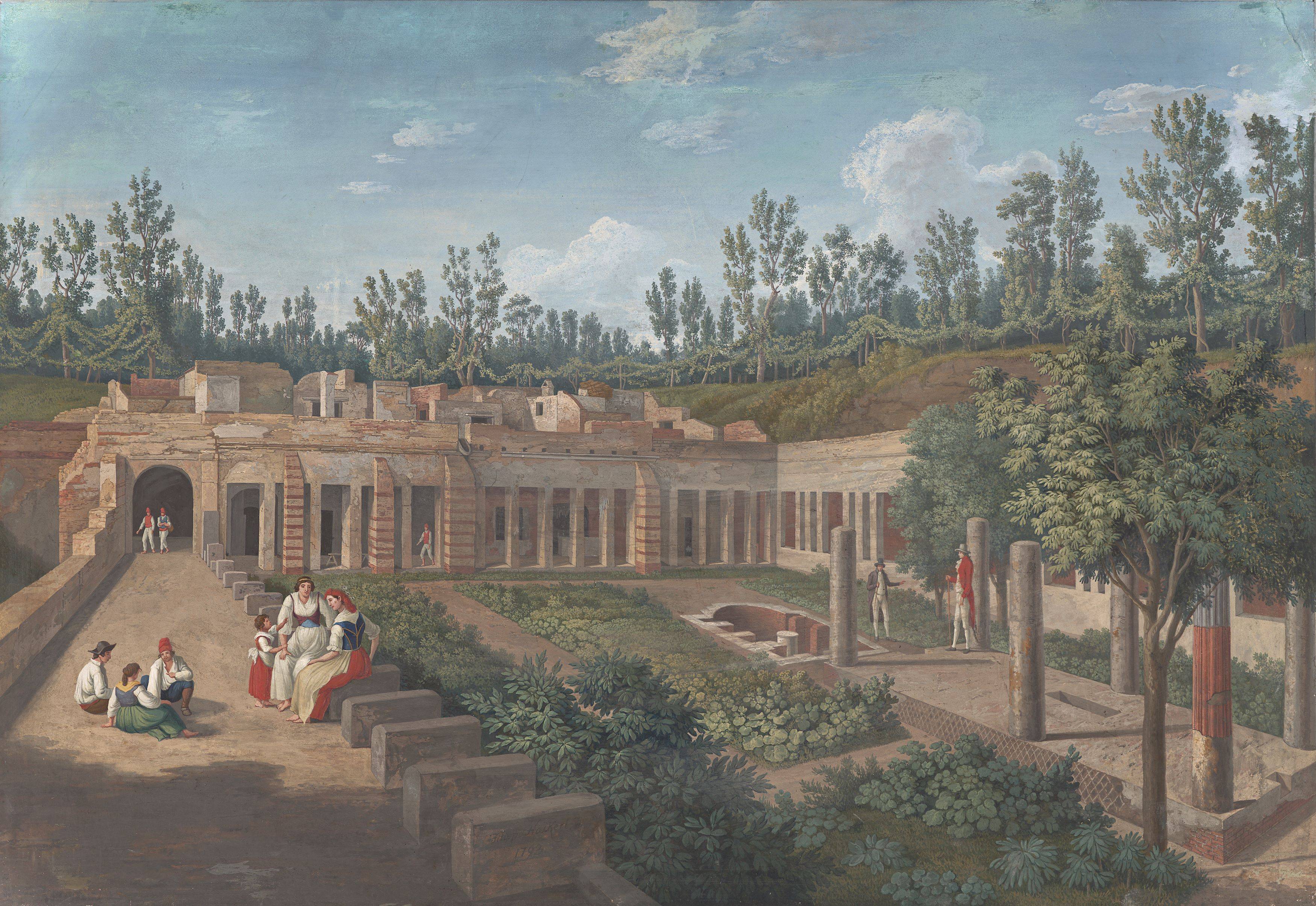
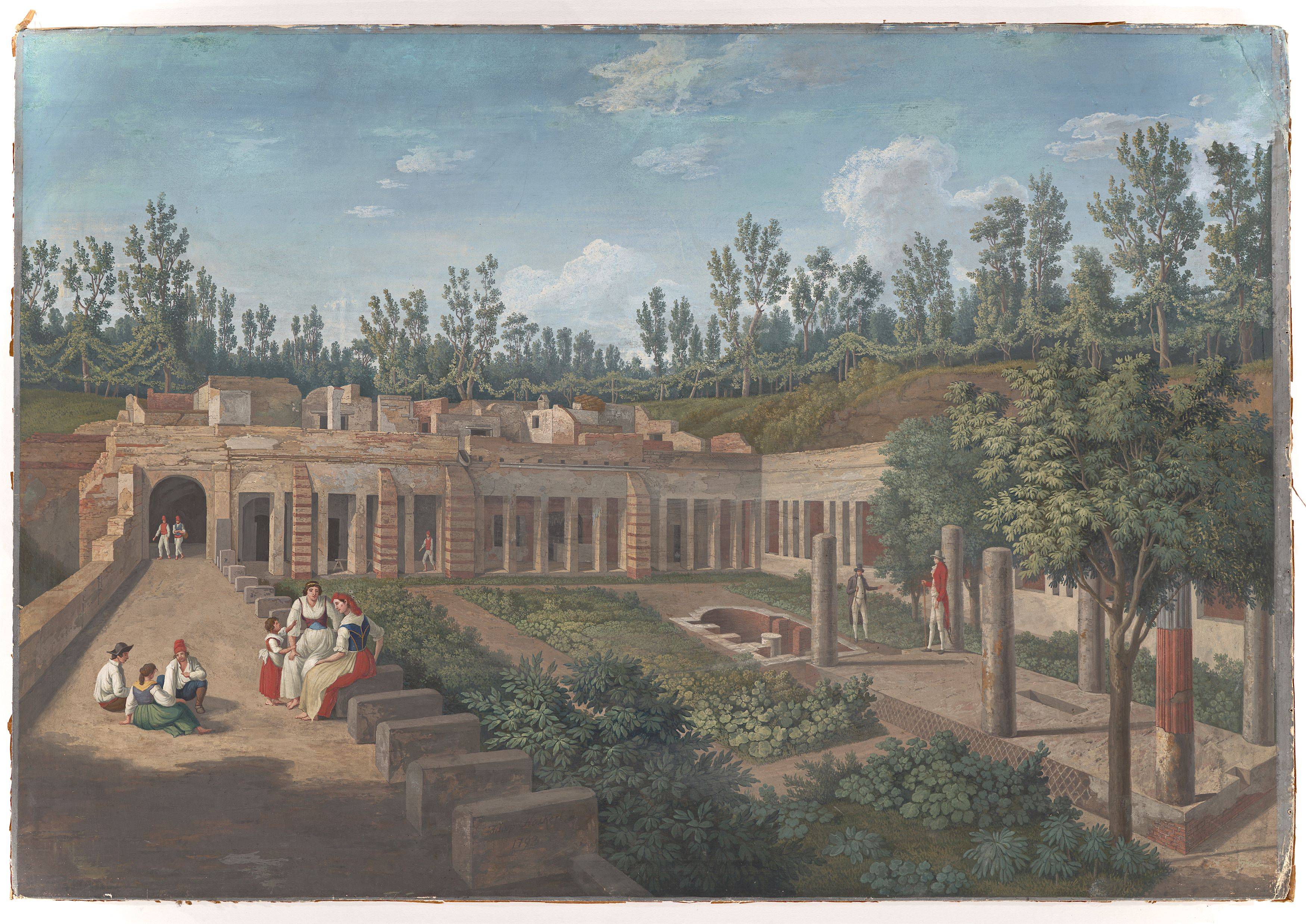
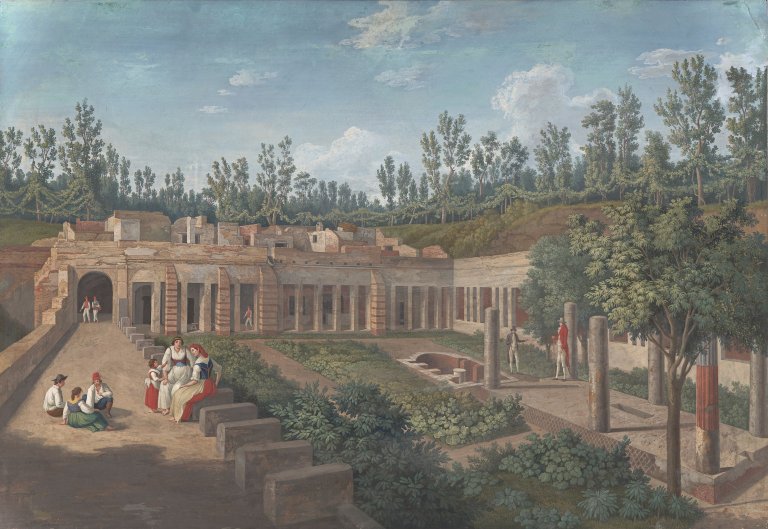
Gouache on paper, mounted on heavy cardboard.
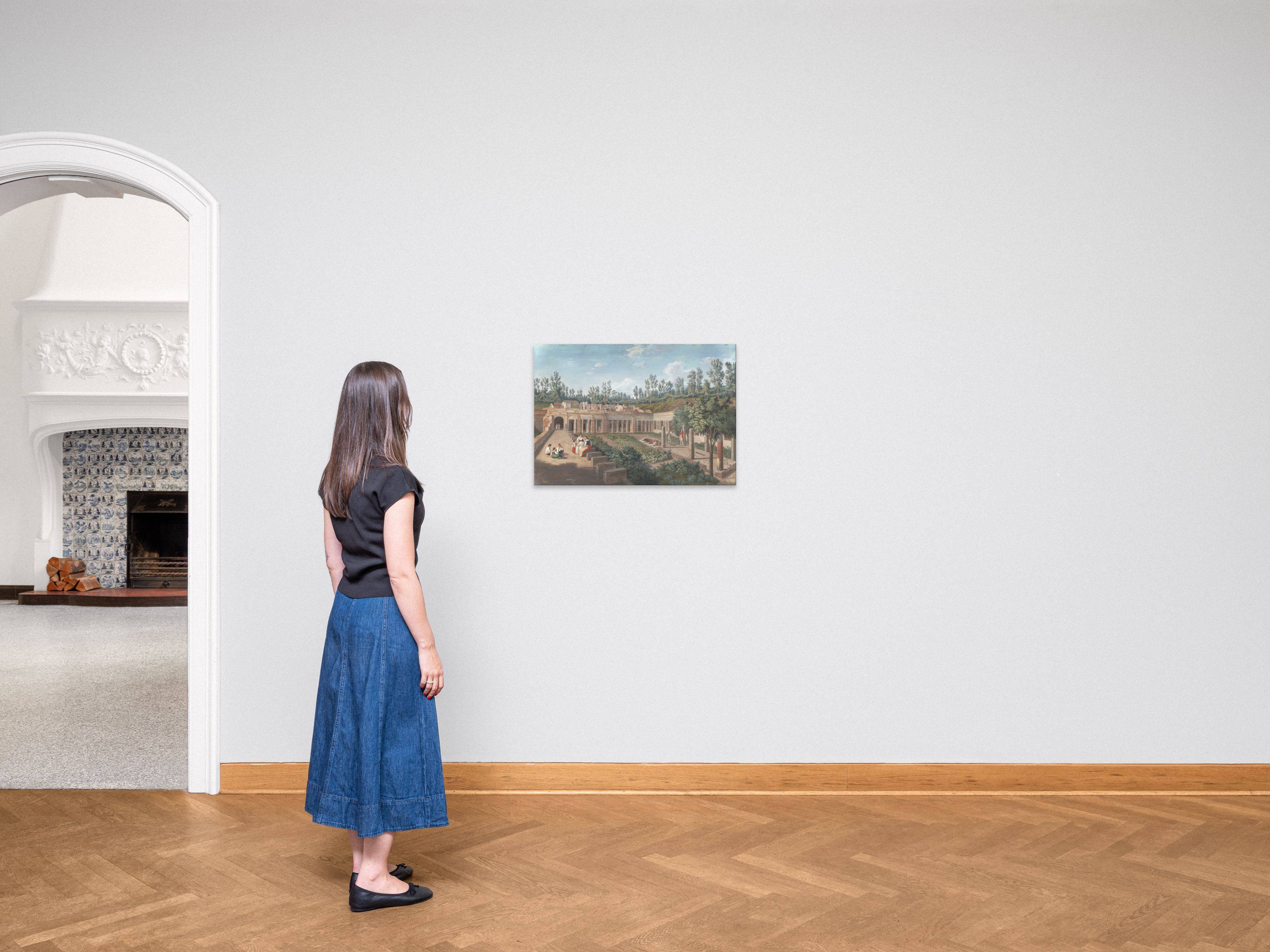
56 × 80 cm
(22 × 31 ½ in.).
Signed and dated in the stone in the lower centre: Filippo Hackert 179.
Catalogue raisonné: Nordhoff 237.
[3037]
Framed
Private Collection, Berlin
Reinhard Wegner: Pompeji in Ansichten Jakob Philipp Hackerts. In: Zeitschrift für Kunstgeschichte, Issue 55, 1992, p. 66–96, ill. 8
Hackert depicts a view from the west of Diomedes' villa in Pompeii, located outside the city walls at the Herculaneum Gate on the Via dei Sepolcri. The excavations in the ancient city of Vesuvius, which began in 1748, were carried out behind closed doors, with the finds published in large, magnificent volumes entitled Antichità di Ercolano esposte. Outside artists were strictly forbidden from drawing – they bribed the guards to gain access to Pompeii. Hackert did not need to do this. As the first court painter in Naples since April 1786, he had access to the king at any time; his friendship with the head of excavations in Pompeii, the archaeologist Francesco La Vega, will have done the rest. Hackert received official permission to paint in Pompeii. The project was to be a major undertaking: the artist planned a series of six views of important Pompeian monuments, which his brother Georg Hackert was to transfer to etching. In December 1792, as we read in a letter dated the 4th of that month to the Courland baron Heinrich von Offenberg, he was eagerly at work: ‘In Pompejana I have made six views, which I am now painting in gouache and which Georg will engrave; this is something curious and new for the European public.’ In 1794, the gouaches, two of which are now in the Klassik Stiftung Weimar and one in the Leipzig Museum of Fine Arts, were completed; the etchings took until 1797 to finish. Hackert's certainty that this series of paintings, which he described as ‘curious new works’, would sell well to Grand Tour audiences is reminiscent of the artist's business acumen. Regardless of this, however, he was first and foremost a landscape painter, and this is what makes the sixth and last gouache in the cycle, which he himself described as ‘Landhauß’ (country house), so appealing. Delicate trees grow between the ancient columns of the courtyard, low bushes cover the ground in garden beds, and vines climb mulberry trees above the surrounding wall, a practice common in the Naples area. The picture provides a faithful documentation of the ancient villa – but it is also a garden idyll in a landscape that, according to Goethe in his Italian Journey (14 March 1787), ‘is entirely a garden’. Perhaps the most beautiful thing one could find on a walk through Pompeii. Claudia Nordhoff
This website uses services for operation, statistical evaluations, the display and sharing of content from social networks, and interest-based advertising. These services make the website usable, improve your browsing experience, enable interactions with networks, and display relevant advertisements. Activate the desired services in the respective categories to accept them.
More information
By clicking on "Confirm selection" or "Select all & confirm", you consent to your data being processed by the respective services.
The activated services do not affect your browser configuration. Cookies from these services are deleted when the browser is closed or must be manually deleted if they are not valid beyond the specified time, depending on the browser configuration.
Settings
This service is used to manage the consent manager.
Name
Type
Expiration
Description
z7_consent_manager
Cookie
1 year
Stores the value of the user selection.
The service will show a warning when clicking on external links.
Name
Type
Expiration
Description
ext_Urls_whitelist
Cookie
30 days
List of external links accepted by the user.
Name
Type
Expiration
Description
laravel_session
Cookie
2 hours
This cookie is used to manage the session of the website.
XSRF-TOKEN
Cookie
2 hours
This cookie is used to protect the website from CSRF attacks.