Arsène Alexandre: Honoré Daumier. L'homme et l'œuvre. Paris, Renouard Laurens, 1888, no. 376 / Raymond Escholier: Daumier. Peintre et Lithographe. Paris, Floury, 1923, ill. pl. opposite p. 74 / Erich Klossowski: Honoré Daumier. 2nd, improved ed. Munich, Piper, 1923, no. 331 / Léon Marotte, Charles Martine: Dessins de Maîtres Français, vol. IV. Honoré Daumier. Paris, 1924, no. 20 / Eduard Fuchs: Der Maler Daumier. Munich, A. Langen, 1927, no. 226b / Karl Eric Maison: Daumier Drawings. New York/London, 1961, ill. 27 / Karl Eric Maison: Honoré Daumier. Catalogue Raisonné of the Paintings, Watercolours and Drawings. London, Thames & Hudson, 1967/68, no. 252
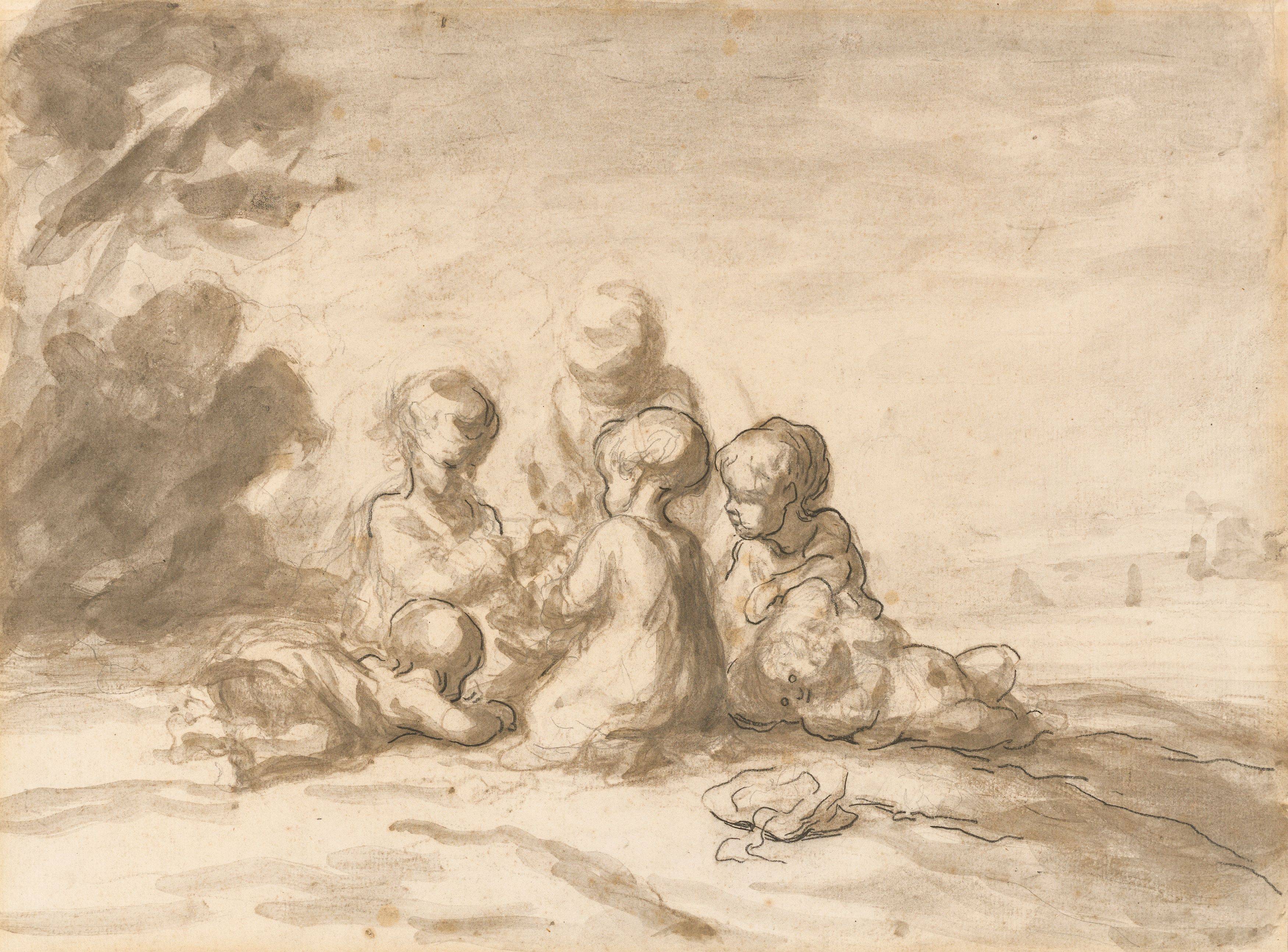
Aside from his main satirical path, Daumier reveals himself to be surprisingly uninhibited in his roots of tradition. The culture of the 18th century, which in his youth had been the despised symbol of the old tyranny, returned in idealised form in the middle of the century. Dixhuitième collectors such as the Goncourt brothers, who as royalists admired Daumier's satirical fire only from a respectful distance, would perhaps have loved the large composition presented here without reservation.
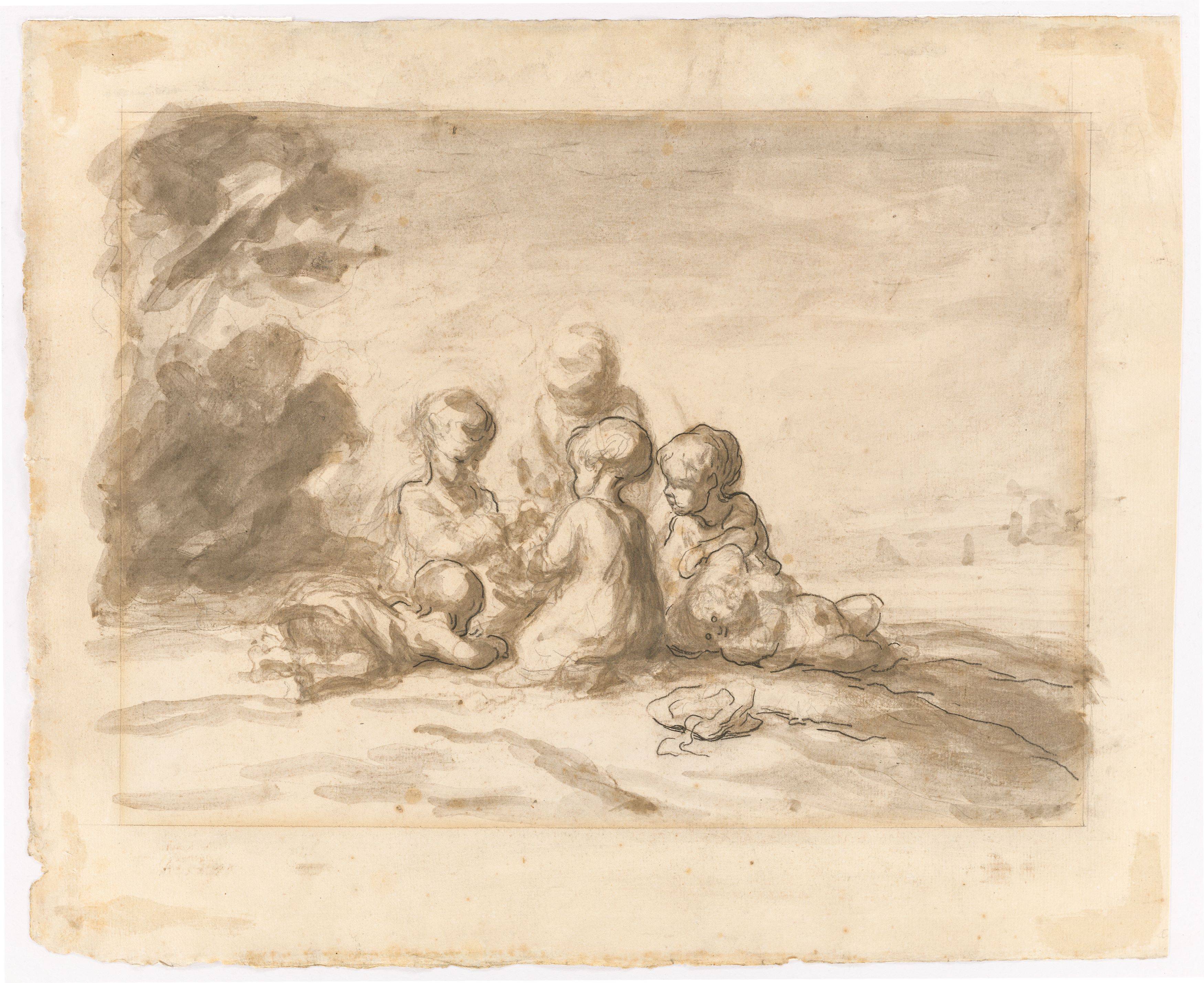
Admittedly, the idyllic landscape, stirred by a light breeze, bears no resemblance to Daumier's dimly lit Seine quays, where harried washerwomen drag their children behind them; but for all their timeless grace, it is the same proletarian children with protruding occiputs and thin necks that arrange the drawing into a softly curving yet immaculately symmetrical pyramid (the upper figure could represent the mother).
The first tentative pencil strokes disappear almost completely under the delicate chiaroscuro of the brushstrokes, a soft modelling that allows light to pass through, binding the group to the surrounding pastoral scene. Finally, fleeting strokes of a sharply pointed Crayon Conté gently swell the forms here and there without closing them completely.
When might this composition have been created? Related groupings can be seen in a drawing of the Detroit Institute of Arts and another in the Hamburger Kunsthalle, the latter of which also features a number of pictorial notes scattered across the remaining space and the reverse side, including sketches for lithographs, most of which appear to have been created between 1850 and 1853 (while only two sketches on the reverse must have been added in 1866). Thus, our composition, which solves the ‘problem’ of the Hamburg drawing in a classical manner, could also have been created around the time Daumier was 45 years old. Claude Keisch
This website uses services for operation, statistical evaluations, the display and sharing of content from social networks, and interest-based advertising. These services make the website usable, improve your browsing experience, enable interactions with networks, and display relevant advertisements. Activate the desired services in the respective categories to accept them.
More information
By clicking on "Confirm selection" or "Select all & confirm", you consent to your data being processed by the respective services.
The activated services do not affect your browser configuration. Cookies from these services are deleted when the browser is closed or must be manually deleted if they are not valid beyond the specified time, depending on the browser configuration.
Settings
This service is used to manage the consent manager.
Name
Type
Expiration
Description
z7_consent_manager
Cookie
1 year
Stores the value of the user selection.
The service will show a warning when clicking on external links.
Name
Type
Expiration
Description
ext_Urls_whitelist
Cookie
30 days
List of external links accepted by the user.
Name
Type
Expiration
Description
laravel_session
Cookie
2 hours
This cookie is used to manage the session of the website.
XSRF-TOKEN
Cookie
2 hours
This cookie is used to protect the website from CSRF attacks.